
Description
Sixteen outputs, 16,320 pixels — the economical choice when power is injected separately anyway
The PixLite® E16-S Mk3 is the data controller of the E series: it drives up to sixteen pixel strings with the full Mk3 feature set but carries no pixel power — you inject the pixel supply directly from the power supply into the string. In return it is small, light and considerably cheaper than the A series. It is configured in the browser, and with a microSD card it plays a show even without a computer attached.
- Is it right for my project?
- Technical data
- Wiring
- Compatibility
- Scope of delivery
- Frequently asked questions
Is it right for my project?
What this controller is made for
- Set-ups of up to around 16,000 pixels where the pixel power is injected directly anyway — long strings with several injection points, Christmas displays, trade-fair stands, stage sets
- Projects on a tight budget: Mk3 processor, 90+ protocols, SHOWTime™ and browser configuration at an entry-level price
- Little space: 114.5 × 149.5 × 35.5 mm, 200 g, on a flat surface or on a DIN rail with the kit
- Stand-alone shows from microSD when no computer should run permanently
Not for
- Power and data from one unit without separate injection — that is what the A series is for: A4-S Mk3 with powered outputs and electronic fuses
- Small set-ups up to around 4,000 pixels: the E4-S Mk3 with four outputs is enough and costs less — see all Art-Net/E1.31 controllers
- Long distances between controller and pixels — that is what the long-range systems are for (T8-S Mk3, T16X-S Mk3)
- Direct outdoor mounting without an enclosure: the unit is designed for installation, not for rain
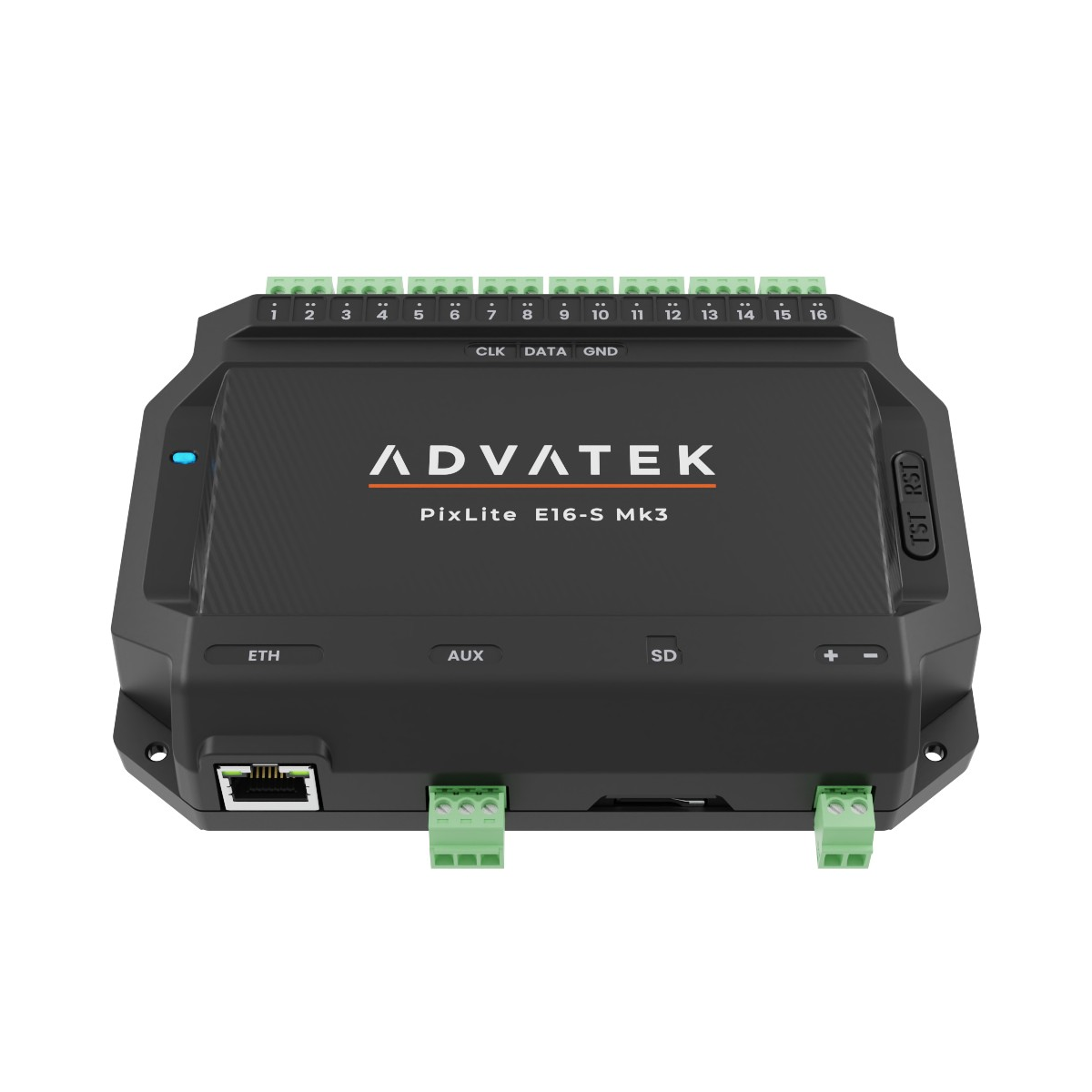
Three pins per output: CLK, DATA, GND
- Each output carries data only — clock, data and ground. The pixel power goes straight from the power supply into the string; the controller stays cool and small
- Pluggable screw terminals: pre-assemble the strings, plug in, done
- Fault protection on all ports: pixel outputs withstand up to ±36 V DC, the AUX port ±48 V DC fault voltage, the supply input is protected against reverse polarity
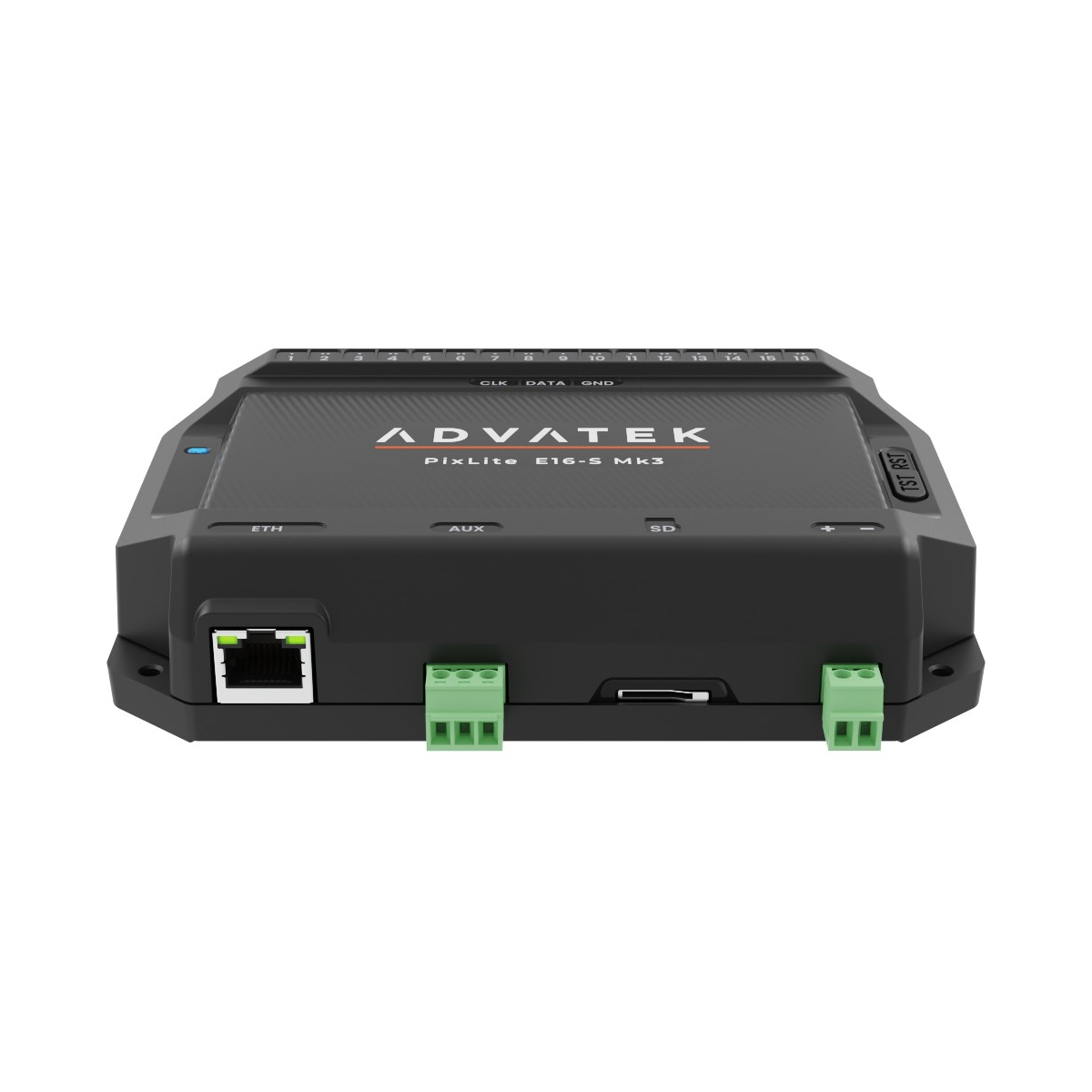
Flat enough for any distribution board
- 114.5 × 149.5 × 35.5 mm and 200 g — fits into sub-distributions, display bases and enclosures where no full-size controller fits any more
- Screw onto a flat surface or put it on the DIN rail with the DIN rail kit
- One Ethernet port (10/100 Mbit/s), AUX port for DMX512 in or out, microSD for SHOWTime™
Wiring
Up and running in four steps
- Power the controller. 5–24 V DC to the + and − terminals — usually from the same power supply that also feeds the pixels.
- Connect the pixels. Per output CLK, DATA and GND. For chipsets without a clock line, such as WS2811, CLK stays free. Inject the pixel power (+ and −) directly from the power supply into the string; the ground of the power supply is connected to the controller via GND.
- Connect the network. ETH to the switch or computer. The address is in the quick start guide.
- Configure in the browser. Set outputs, universes, protocol and brightness limit, test, done.
Compatibility
Software
- MADRIX, Pharos, MadMapper, Green Hippo, ArKaos, Resolume, Chromateq, Obsidian, Disguise
- xLights and any other source that outputs sACN or Art-Net — the licences we offer are under Software
- Configuration without extra software directly in the browser
Pixels and series
- More than 90 pixel protocols, including WS2811, WS2812B, WS2815, SK6812, APA102, TM18xx — full list and matching pixels
- E series like this unit: outputs data only, power is injected separately
- A series (A4-S Mk3): power runs through the controller — not a direct replacement for each other
Scope of delivery
- PixLite® E16-S Mk3 controller with pluggable terminals
Power supply, pixels, microSD card and DIN rail kit are not included. A conformal-coated version for harsh environments is available on request.
Documents
Datasheet, processor datasheet, quick start guide, user manual and management guide are in the documents section on this page.
Frequently asked questions
Do I need a power supply as well?
How does the E series differ from the A series?
How many pixels can the unit really handle?
Does a show run without a computer?
Unsure about power supply, injection and string layout? Describe your project to us — we work out the power budget and parts list and get back to you with a proposal.
Discuss your projectTechnical data
| Item information | Value |
|---|---|
| Control protocol: | Art-Net / sACN (E1.31) / DMX512 |
| Ambient operating temperature: | -20 °C to +70 °C |
| Enclosure: | ABS |
| Input voltage: | 5–24 V DC (controller only) |
| Pixel outputs: | 16 non-powered (expanded mode: up to 32) |
| Ethernet ports: | 1 × 10/100 Mbit/s |
| Auxiliary port: | RS485 (DMX in/out) |
| Card slot: | microSD (card not included) |
| Mounting: | Flat surface or DIN rail (kit sold separately) |
| Pixels per output: | up to 1,020 RGB / 768 RGBW |
| Universes: | up to 96 (sACN / Art-Net) |
| Dimensions: | 114.5 × 149.5 × 35.5 mm |
| Show storage: | microSD, SHOWTime™ up to 25 triggers |
| Image processing: | Gamma correction and dithering |
| Power consumption: | max. 3.5 W |
| Weight: | 0.2 kg |
| WEEE-Reg.-Nr.: | DE 32487762 |
| Shipping weight: | 0,50 kg |
| Content: | 1,00 unit |
Unit 1, 3 - 5 Gilda Court, Mulgrave
3170 VIC
Australien
support@advateklights.com


