
Description
Four powered outputs for data-only pixels at the end of the long-range line
The PixLite® R4D-S is the receiver for the long-range transmitter T8-S Mk3: it sits up to 300 m from the transmitter right at the pixels, takes the data in over a network cable and outputs it on four fused outputs together with the pixel power. Designed for data-only pixels such as WS2811, WS2812B or SK6812 — the transmitter runs the line in expanded mode with four outputs of 510 pixels each.
Is it right for my project?
What this receiver is made for
- As the counterpart to the T8-S Mk3 — one receiver per line, up to eight on the transmitter
- Four shorter pixel strings of up to 510 RGB pixels each directly at the receiver, powered from a local power supply (5–24 V, up to 6 A per output, 24 A in total) — more strings, fewer injection points
- Data-only pixels: WS2811, WS2812B, WS2815, SK6812 and all other chips without a clock line
- Little space: 95 × 78 × 33 mm, on a flat surface or on a DIN rail with the kit
Not for
- Clocked pixels (CLK + DATA) such as APA102 or long strings of up to 1,020 pixels per output: that is what the R2F-S with two outputs is for
- On the T16X-S Mk3: there the R1F-S and R2F-S work, not the R4D-S
- Without a transmitter: the R4D-S only understands the long-range signal — no Art-Net, no sACN, no network connection
- Direct outdoor mounting without an enclosure: the unit is designed for installation, not for rain
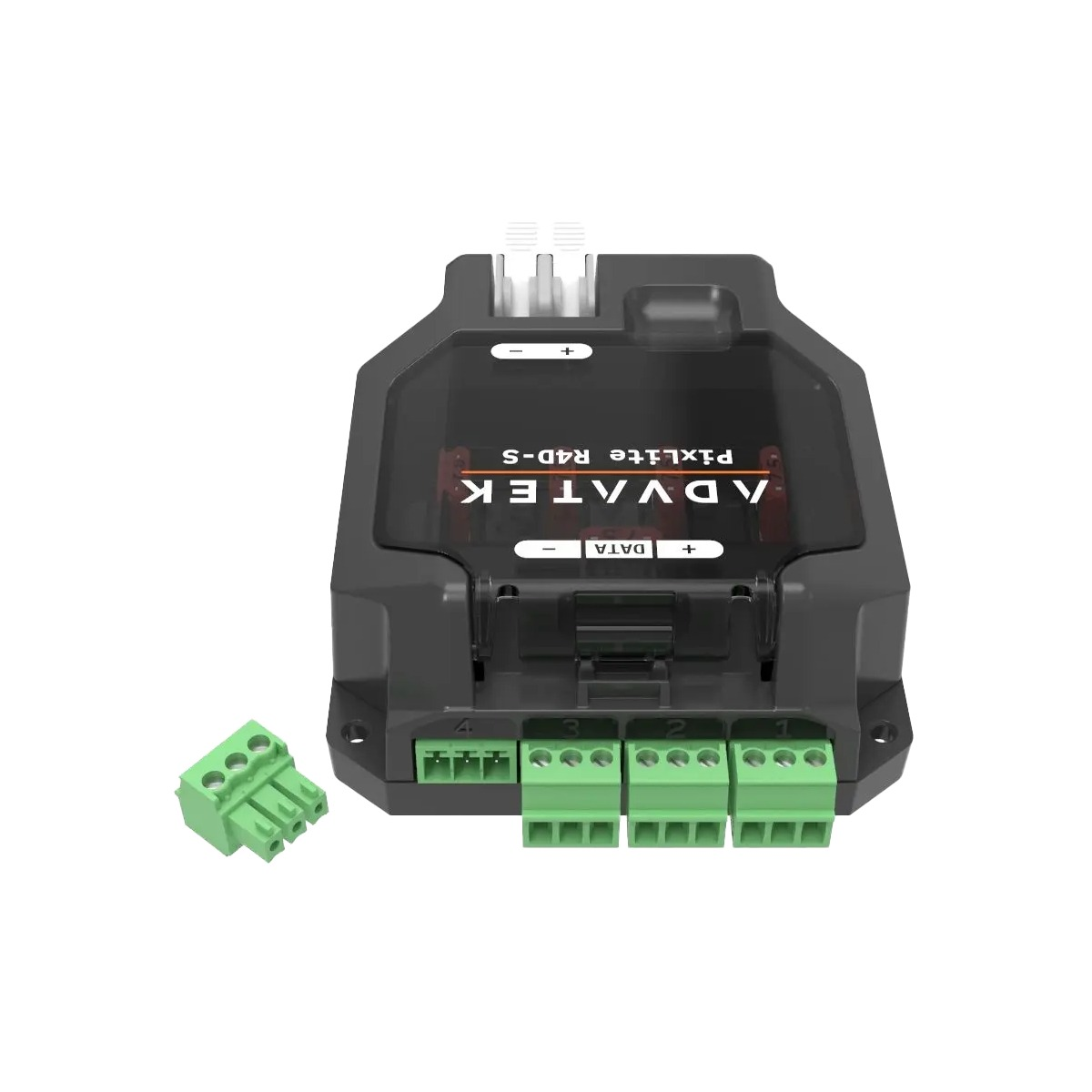
Four strings, four fuses, one power supply
- Each output carries the supply voltage: up to 6 A per output, 24 A through the unit — no separate injector at the start of the string
- One 7.5 A mini blade fuse per output (automotive standard, under the flap): protects pixels and power supply in a fault, the "Fuse good" LED shows the state
- Power via a quick-connect clamp for thick cables; fault protection on all ports: reverse polarity, ESD, ±24 V DC on data and output lines, over-current and short circuit on the outputs
Wiring
Up and running in three steps
- Mount and power the receiver. At the pixels, screw it onto a flat surface or put it on the DIN rail with the DIN rail kit; power supply in the pixel voltage (5, 12 or 24 V) to the quick-connect clamp.
- Connect the pixels. Per output +, DATA and −.
- Connect to the transmitter. Network cable from the T8-S output into the RJ45 socket (up to 300 m); on the transmitter, set the line to expanded mode in the browser and assign the universes.
Scope of delivery
- PixLite® R4D-S long-range receiver with pluggable terminals
- Installation guide
Transmitter, power supply, pixels, network cable and DIN rail kit are not included.
Documents
Datasheet, long-range quick start guide and user manual are in the documents section on this page. Which pixels the system understands is in the protocol list — it applies to the transmitter.
Frequently asked questions
How many pixels can one R4D-S handle?
Why data-only pixels only?
What happens when a fuse blows?
Unsure about receiver choice, power supplies and cable routing? Describe your project to us — we work out the power budget and parts list and get back to you with a proposal.
Discuss your projectTechnical data
| Item information | Value |
|---|---|
| Ambient operating temperature: | -20 °C to +55 °C |
| Enclosure: | ABS |
| Input voltage: | 5–24 V DC |
| Output current: | 6 A per output / 24 A total |
| Pixel outputs: | 4 |
| Mounting: | Flat surface or DIN rail (kit sold separately) |
| Pixels per output: | up to 510 RGB / 384 RGBW |
| Universes: | 12 |
| Dimensions: | 95 × 78 × 33 mm |
| Weight: | 0.2 kg |
| Matching transmitter: | T8-S Mk3 |
| Pixel type: | Data-only (expanded mode) |
| Fuse per output: | 7.5 A mini blade fuse |
| Data input: | 1 × RJ45 from the transmitter (up to 300 m) |
| Pixel power supply: | via the outputs |
| Shipping weight: | 0,30 kg |
Unit 1, 3 - 5 Gilda Court, Mulgrave
3170 VIC
Australien
support@advateklights.com
Maybachstraße 8
Baden-Württemberg
Karlsruhe, Deutschland, 76227
info@pixltec.de


