
Description
Four outputs, 4,080 pixels, power and data from one unit
The PixLite® A4-S Mk3 drives up to four pixel strings and distributes their power at the same time — no separate power injection needed. It is configured in the browser without extra software, and with a microSD card it plays a show even without a computer attached.
- Is it right for my project?
- Technical data
- Wiring
- Compatibility
- Scope of delivery
- Frequently asked questions
Is it right for my project?
What this controller is made for
- Set-ups of up to around 4,000 pixels on one unit — Christmas displays, trade-fair stands, stage sets, façade elements
- Installations where data output and pixel power distribution should come from one unit, without separate power injectors
- Continuous operation: the aluminium base dissipates the heat, no external cooling required
- Stand-alone shows from microSD when no computer should run permanently
- Wall or DIN-rail mounting in the control cabinet
Not for
- More than 4,080 RGB pixels: then the T8-S Mk3 or an E-series unit with separate power injection — see all Art-Net/E1.31 controllers
- Long distances between controller and pixels — that is what the long-range variants with receiver cards are for (T16X-S Mk3 with R1F-S receivers)
- Direct outdoor mounting without an enclosure: the unit is designed for installation, not for rain
Also required: a power supply matching the voltage of your pixels (5 V, 12 V
or 24 V) and the pixels themselves. Matching power supplies and
xConnect® cabling are in our range.
4,080RGB pixels in total (4 × 1,020)
24universes sACN / Art-Net
7 Aper output, 28 A in total
90+supported pixel protocols
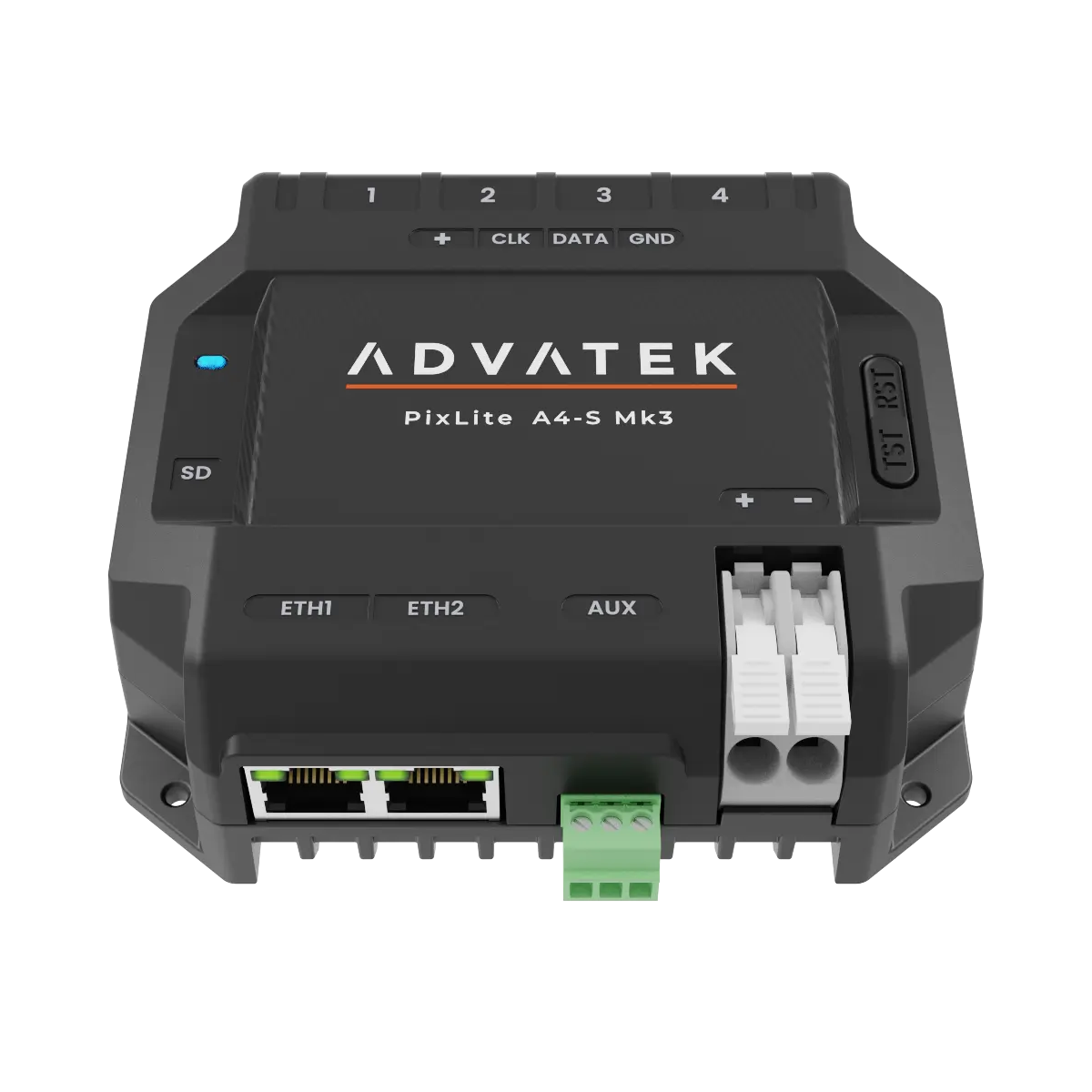
Two network ports, one cable run
- Two Gigabit ports: daisy-chain several controllers without running a separate cable from the switch to every unit
- The AUX port receives DMX512 or outputs it
- A hardware firewall filters foreign universes right at the network interface — latency stays low even when many universes travel through the network
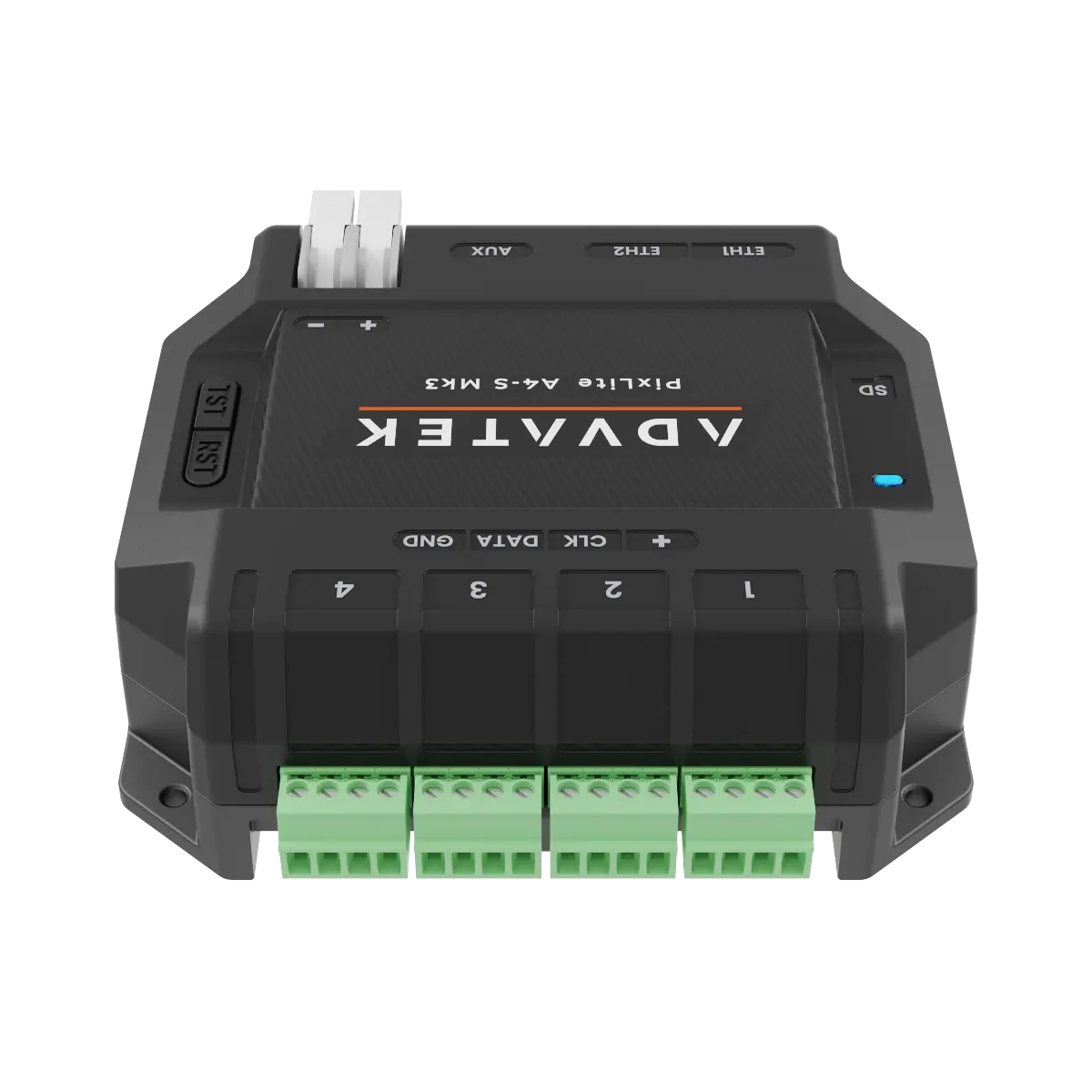
Power and data on the same terminal
- Every output carries the pixel supply voltage: up to 7 A per output, 28 A through the unit — within these limits no separate power injector is needed
- Electronic fuse on every output: if it trips, the controller tries to re-enable the output by itself — no fuse to replace
- Current per output and the state of every fuse can be read out
Wiring
Up and running in four steps
- Choose the voltage. Connect a power supply matching your pixels — 5 V, 12 V or 24 V to the push-in terminals. This voltage is then also present at the pixel outputs.
- Connect the pixels. Per output +, CLK, DATA and GND. With chipsets without a clock line, such as WS2811, CLK stays unconnected.
- Connect the network. ETH1 to the switch or computer, ETH2 on to the next controller. The address is in the quick start guide.
- Configure in the browser. Set outputs, universes, protocol and brightness limit, test, done.
Caution: power supply and pixels must have the same voltage. 12 V on
5 V pixels destroys them immediately — and the electronic fuse does not help here either,
because it protects against overcurrent, not overvoltage.
Compatibility
Software
- MADRIX, Pharos, MadMapper, Green Hippo, ArKaos, Resolume, Chromateq, Obsidian, Disguise
- xLights and any other source that outputs sACN or Art-Net — the licences we offer are listed under Software
- Configuration directly in the browser, no additional software
Pixels and series
- More than 90 pixel protocols, including WS2811, WS2812B, WS2815, SK6812, APA102, TM18xx — full list and matching pixels
- A series like this unit: power runs through the controller
- E series: outputs data only and needs its own power injection — not a direct replacement
Scope of delivery
- PixLite® A4-S Mk3 controller
Power supply, pixels and microSD card are not included. A variant with conformal coating for harsh environments is available on request.
Documents
Datasheet, processor datasheet and quick start guide are in the documents section of this page.
Frequently asked questions
Do I need a power supply as well?
Yes. The controller distributes power to the pixels but does not generate
it. The input voltage is between 5 and 24 V and depends on the pixels used. As a rule of thumb
for sizing: WS2811 pixels draw around 60 mA per pixel at full brightness. Matching power
supplies are under Power supplies.
What is the difference between the A series and the E series?
The A series routes the pixel power through the controller — connect the
power supply, connect the pixels, done. The E series outputs data only; there the power has to
be injected separately. An E-series unit is therefore not a direct replacement for an existing
A-series set-up.
How many pixels can the unit really drive?
1,020 RGB pixels per output, i.e. 4,080 in total. The second limit is
current: 7 A per output and 28 A in total. With power-hungry pixels at full brightness this
limit is reached before the pixel count — then split the strings or inject additional power.
Does a show run without a computer?
Yes, via SHOWTime™: the show is written to a microSD card and
played back by the controller on its own, with up to 25 triggers. A permanently running
computer is not required.
Can I daisy-chain several controllers?
Yes. ETH1 comes from the switch, ETH2 goes on to the next unit. So not
every controller needs its own cable to the switch.
Unsure about power supply, injection and string layout? Describe your project to us — we calculate power requirements and the parts list and get back to you with a proposal.
Discuss your projectTechnical data
| Item information | Value |
|---|---|
| Control protocol: | Art-Net / sACN (E1.31) / DMX512 |
| Ambient operating temperature: | -20 °C to +70 °C |
| Enclosure: | Aluminium and ABS |
| Input voltage: | 5–24 V DC |
| Output current: | 7 A per output / 28 A total |
| Pixel outputs: | 4 (expanded mode: up to 8) |
| Ethernet ports: | 2 × Gigabit |
| Auxiliary port: | RS485 (DMX in/out) |
| Card slot: | microSD (card not included) |
| Mounting: | Wall or DIN rail |
| Pixels per output: | up to 1,020 RGB / 768 RGBW |
| Universes: | up to 24 (sACN / Art-Net) |
| Dimensions: | 126.5 × 119 × 42 mm |
| Show storage: | microSD, SHOWTime™ up to 25 triggers |
| Image processing: | Gamma correction and dithering |
| Shipping weight: | 0,50 kg |
| Content: | 1,00 unit |
Product safety information
Manufacturer information:
Advatek
Unit 1, 3 - 5 Gilda Court, Mulgrave
3170 VIC
Australien
support@advateklights.com
Unit 1, 3 - 5 Gilda Court, Mulgrave
3170 VIC
Australien
support@advateklights.com


