
Description
One output, up to 48 V, right at the pixel string — the smallest long-range receiver
The PixLite® R1F-S is the receiver for the long-range transmitter T16X-S Mk3: only 72 × 39 × 31 mm, mounted up to 300 m from the transmitter right at the start of the string. It takes the data in over a network cable and outputs it on one powered output together with the pixel power — up to 48 V and 10 A, for clocked and data-only pixels. Brackets for flat surfaces, tubes and DIN rail are included.
Is it right for my project?
What this receiver is made for
- As the counterpart to the T16X-S Mk3 — one receiver per line, up to sixteen on the transmitter
- One pixel string of up to 1,020 RGB pixels directly at the receiver, powered from a local power supply — 5 to 48 V, up to 10 A: also 36 V and 48 V systems with long strings
- All pixel types: clocked (CLK + DAT) such as APA102 or data-only such as WS2811
- Almost no space: 72 × 39 × 31 mm and 54 g — fits into poles, profiles and display bases; brackets for flat surface, tube from 38 mm and DIN rail are included
Not for
- On the T8-S Mk3: there the R2F-S and R4D-S work, not the R1F-S
- Several strings on one receiver: that is what the R2F-S (two outputs, also on the T16X-S) is for
- Without a transmitter: the R1F-S only understands the long-range signal — no Art-Net, no sACN, no network connection
- Direct outdoor mounting without an enclosure: the unit is designed for installation, not for rain
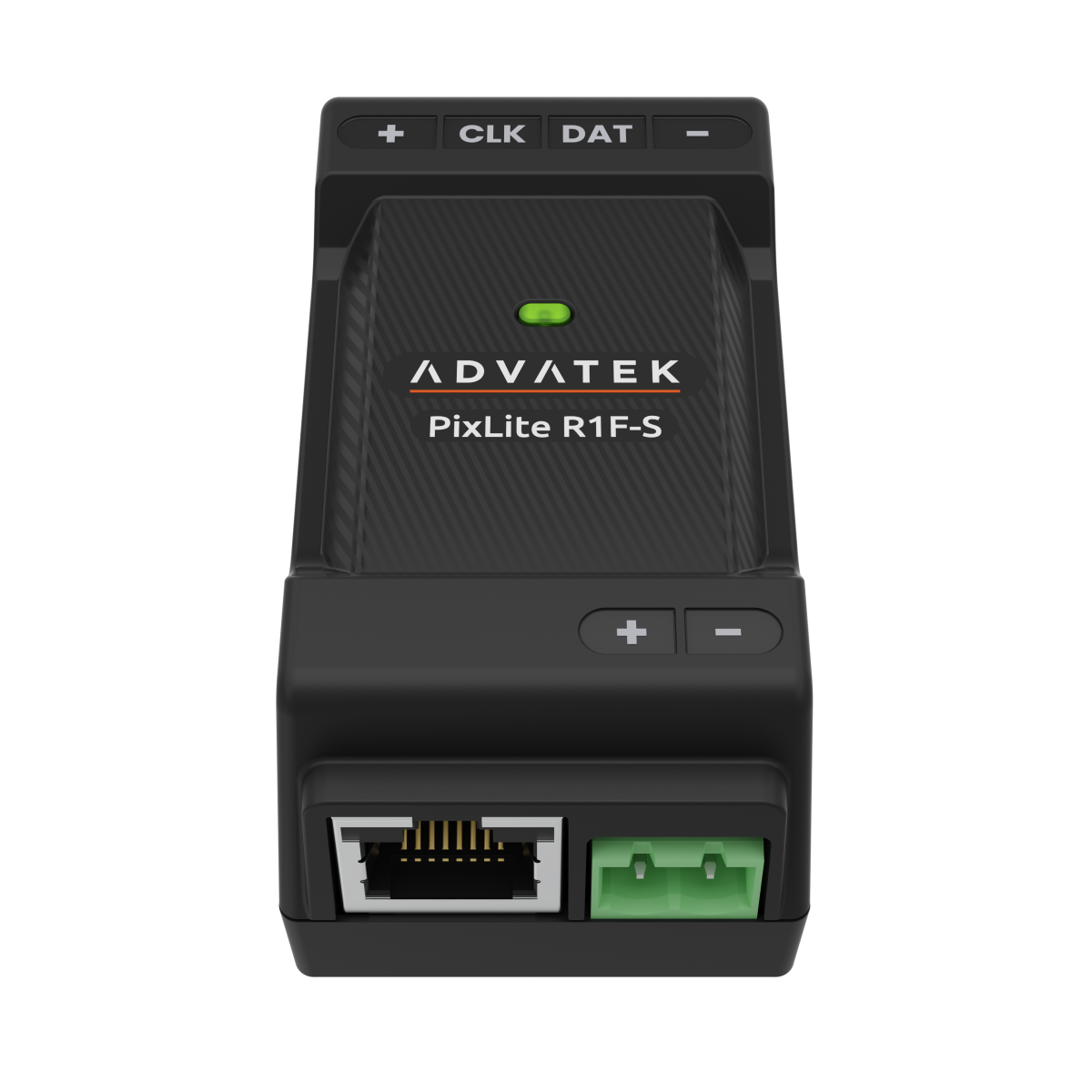
Small, high current, mountable anywhere
- The output carries the supply voltage — up to 10 A pass-through; with power supplies above 10 A a fuse belongs in the feed, the R1F-S has none of its own
- Fault protection on all ports: reverse polarity at the input, ESD, ±48 V DC on data and output lines
- Polycarbonate enclosure with included brackets for flat surface, tube (from 38 mm) and DIN rail; power LED shows the supply
Wiring
Up and running in three steps
- Mount and power the receiver. Fix it at the start of the string with the matching bracket; power supply in the pixel voltage (5–48 V) to the + and − terminal.
- Connect the pixels. +, CLK, DAT and −. For chipsets without a clock line, such as WS2811, CLK stays free.
- Connect to the transmitter. Network cable from the T16X-S output into the RJ45 socket (up to 300 m); outputs and universes are set on the transmitter in the browser.
Scope of delivery
- PixLite® R1F-S long-range receiver
- Mounting kit for flat surface, tube and DIN rail
- Installation guide
Transmitter, power supply, pixels and network cable are not included. A conformal-coated version for harsh environments is available on request.
Documents
Datasheet, long-range quick start guide and user manual are in the documents section on this page. Which pixels the system understands is in the protocol list — it applies to the transmitter.
Frequently asked questions
How many pixels can one R1F-S handle?
Do I need a fuse?
Why up to 48 V?
Unsure about receiver choice, power supplies and cable routing? Describe your project to us — we work out the power budget and parts list and get back to you with a proposal.
Discuss your projectTechnical data
| Item information | Value |
|---|---|
| Ambient operating temperature: | -20 °C to +55 °C |
| Enclosure: | Polycarbonate |
| Input voltage: | 5–48 V DC |
| Output current: | up to 10 A |
| Pixel outputs: | 1 |
| Mounting: | Flat surface, tube from 38 mm or DIN rail (brackets included) |
| Pixels per output: | up to 1,020 RGB / 768 RGBW |
| Universes: | 6 |
| Dimensions: | 72 × 39 × 31 mm |
| Weight: | 54 g |
| Matching transmitter: | T16X-S Mk3 |
| Pixel type: | clocked or data-only |
| Fuse per output: | none — fuse power supplies above 10 A |
| Data input: | 1 × RJ45 from the transmitter (up to 300 m) |
| Pixel power supply: | via the outputs |
| WEEE-Reg.-Nr.: | DE 32487762 |
| Shipping weight: | 0,30 kg |
Unit 1, 3 - 5 Gilda Court, Mulgrave
3170 VIC
Australien
support@advateklights.com
Maybachstraße 8
Baden-Württemberg
Karlsruhe, Deutschland, 76227
info@pixltec.de


