
Description
WS2811 pixel string 12 V DC, round 12 mm pixels, 10 cm pixel pitch, IP68
The string carries 50 or 100 individually addressable RGB pixels with WS2811 chip at a pitch of 10 cm. The pixels are potted (IP68), each wire has a 0.75 mm² cross-section. The string runs on 12 V DC and needs a pixel controller and a suitable power supply. The pixels limit their current with series resistors (resistor), the proven standard version.
Is it right for my project?
What the string is made for
- Pixel mapping and light installations in which every pixel is controlled individually
- Facades, outlines, signs and event technology – the round pixels fit our mounting strips for 12 mm pixels
- Outdoor installations – the pixels are potted to IP68
Not suitable for
- Operation without a pixel controller – on supply voltage alone the pixels do not light up
- Voltages other than 12 V DC, and certainly not mains voltage
- Unprotected JST-SM connectors outdoors – these connectors are not watertight
50/100pixels per string
10 cmpixel pitch
IP68pixels potted
36 Wmax. per 50 pixels
Variants
- 50 pixels · xConnect® connector · black cable · approx. 5 m
- 50 pixels · xConnect® connector · blue/white/red cable · approx. 5 m
- 100 pixels · xConnect® connector · black cable · approx. 10 m
- 50 pixels · JST-SM connector · black cable · approx. 5 m
- 50 pixels · JST-SM connector · blue/white/red cable · approx. 5 m
Choose the variant at the top of this page.
Connection
How to connect the string
- Mind the direction. Data runs in one direction only. Connect the controller to the input of the string – connected the wrong way round, the pixels stay dark.
- Choose the power supply. Allow up to 36 W (3 A at 12 V) per 50 pixels, that is 60 mA per pixel at full white, plus about 20 % reserve.
- Inject power. With several strings in a row the voltage drops. Inject power additionally, with xConnect® for example using the T-connector 10209.
- Switch on. Make all connections first, then switch on the power supply.
Caution: Operate on 12 V DC only. Mate or disconnect only with the power off. If you shorten the string, insulate and seal the cut – IP68 no longer applies there.
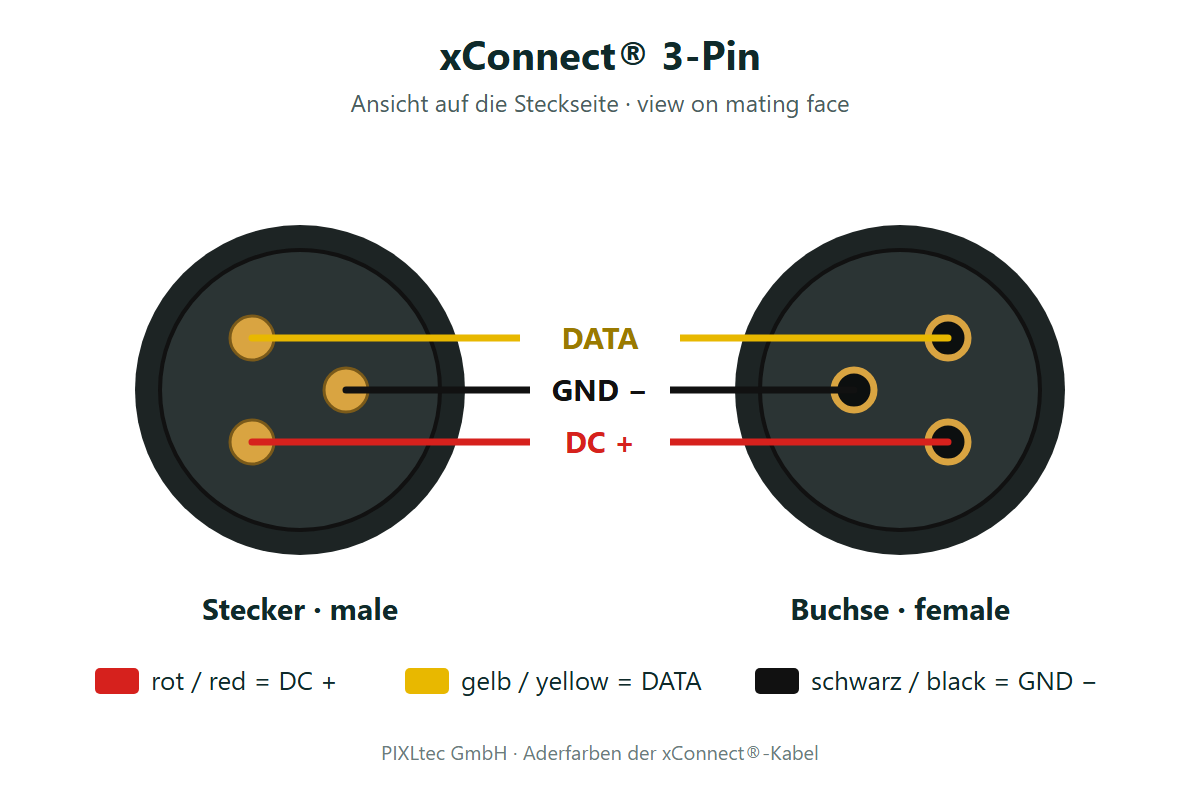
xConnect® pin assignment
The drawing shows the contact assignment of plug and socket of the xConnect® variants. The wire colours in the legend apply to the xConnect® cables; for strings with blue/white/red cable only the assignment at the connector counts.
Scope of delivery
- 1 pixel string in the selected variant, with plug and socket at the ends
- Power supply and controller are not included.
Frequently asked questions
Can I shorten the string?
Yes, after every pixel. Insulate and seal the cut – protection to IP68 no longer applies there.
How much current does the string need?
Up to 60 mA per pixel at full white, i.e. 3 A or 36 W per 50 pixels at 12 V. With colours and effects it is usually less in operation.
What does “resistor” mean?
The pixels limit their current with series resistors. If the voltage drops along the string, the last pixels tend to get darker or change colour – so inject power in good time. For long runs there is the regulated string 10235.
xConnect® or JST-SM?
xConnect® is protected to IP65 when mated and intended for outdoor use. JST-SM is not watertight and needs additional sealing outdoors. Choose the connector to match your controller and extensions.
Are other pixel pitches or lengths available?
Yes, as a custom order from 2,500 pixels – see custom orders.
Technical data
| Item information | Value |
|---|---|
| Ambient operating temperature: | -15 to +60 °C |
| Wire cross-section: | 0.75 mm² |
| Connector system: | xConnect®JST-SM |
| Color depth: | 24 bit (≈16 million colours) |
| Cuttable: | Yes, after each pixel |
| Form factor: | Pixel string |
| Controller IC: | WS2811 |
| Pixel Diameter: | 12 mm |
| WEEE-Reg.-Nr.: | DE 32487762 |
| Cable color: | blackBlue/White/Red |
| Voltage management: | resistor |
| Pixel spacing: | 4 inch (≈ 10 cm) |
| Power (string): | ~ 36 W (50 px)~72 W (100 px) |
| Design current (string): | approx. 3.0 A (50 px @ full white)approx. 6.0 A (100 px @ full white) |
| Length (string): | approx. 5 mapprox. 10 m |
| Operating Voltage: | 12 Volt DC |
| Protection class: | IP68 |
Product safety information
Manufacturer information:
PIXLtec GmbH
Maybachstraße 8
Baden-Württemberg
76227 Karlsruhe
Deutschland
info@pixltec.de
Maybachstraße 8
Baden-Württemberg
76227 Karlsruhe
Deutschland
info@pixltec.de


